
Each year as the annual budget is handed down, there is a conversation about what’s in it for small businesses.
While much of the analysis focuses on programs that are directly targeting SMEs, it is worth looking beyond the headline measures at how some of the investments open the doors for small businesses, either as part of the supply chain, workforce implications, infrastructure investments that will benefit them, and economic and industry development.
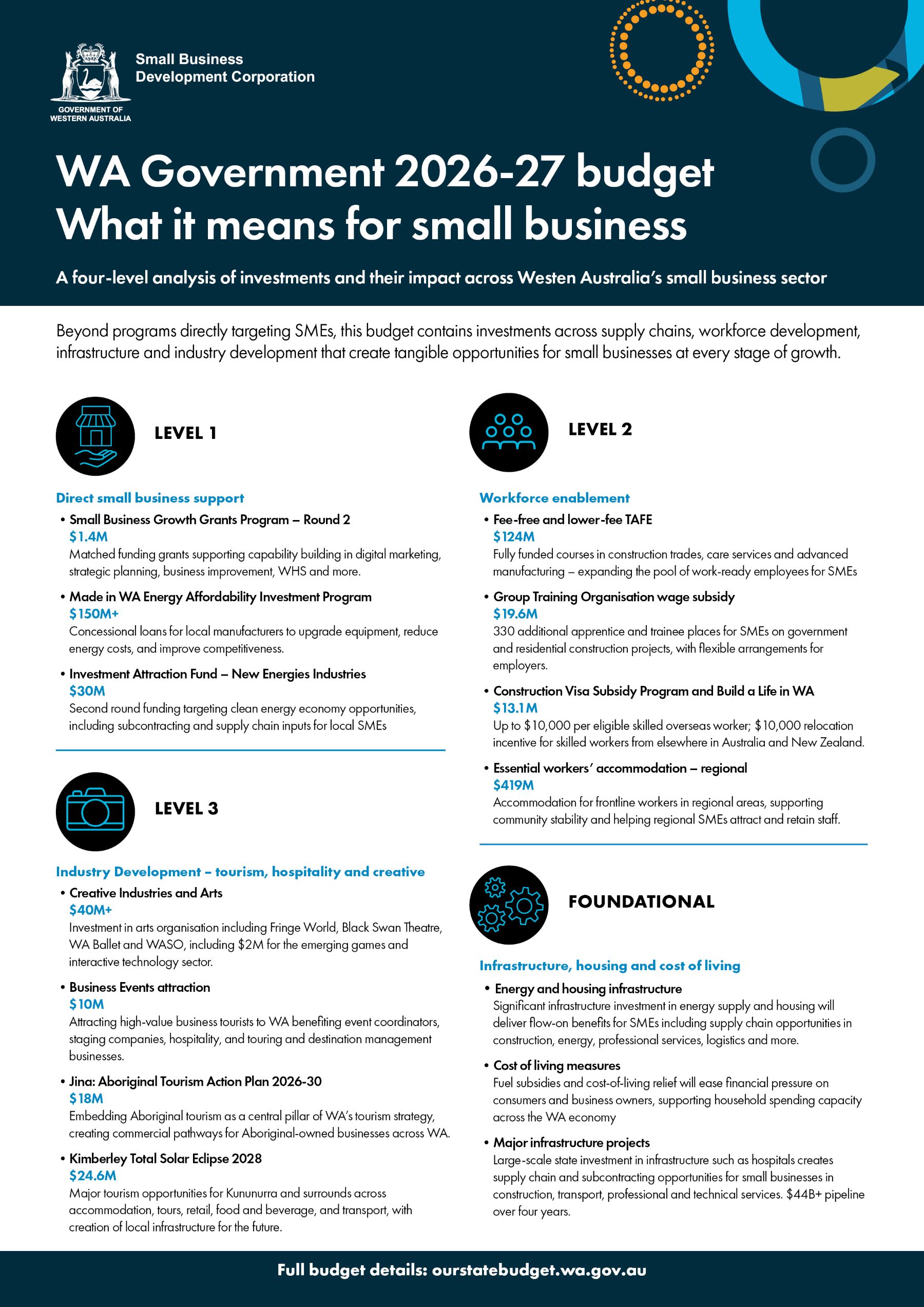
Here is my analysis of 2026-27 WA State Budget, through a small business lens.
Level one: direct small business support
These are the most obvious measures, designed to directly support small businesses with grant funding and concessional loans.
Small Business Growth Grants Program - $1.4 million
We will be running a second round of the Small Business Growth Grants Program, building on the outcomes of the inaugural program last year. The matched funding grants provide direct financial support for small businesses looking to build capability and grow, by subsidising access to expert services and advice.
The first tranche of the program helped more than 100 WA businesses fund business investments including digital marketing strategies, marketing and communications planning, strategic business planning, business improvement and innovation and work health and safety. Watch our website for updates on timing of the Growth Grants round two.
Made in WA Energy Affordability Investment Program - $150 million+
More than $150M will be available in concessional loans to help local manufacturers improve energy efficiency and invest in advanced manufacturing equipment. The loans will be available to help manufacturers upgrade equipment, reduce energy bills, and become more competitive.
Applications for the Made in WA Energy Affordability Investment Program will open in July 2026 via the Department of Energy and Economic Diversification (DEED).
Investment Attraction Fund - New Energies Industries Funding Stream - $30 million
$30 million has been allocated to a second round of the Investment Attraction Fund's New Energies Industries Funding Stream. This funding stream is targeted at creating new business opportunities in Western Australia's clean energy economy, including potential subcontracting and supply chain work for local small businesses. Watch the Invest and Trade website for updates.
Level two: Workforce enablement
One of the biggest challenges for small businesses is securing skilled workers. Initiatives to boost the skilled workforce via training and skilled migration attraction feature strongly in the 2026-27 budget. Many of them are centred on the construction sector – the largest sector for small businesses – however there are also programs to grow the workforces that support our health, care, and lifestyle, and high priority development areas including clean energy and advanced manufacturing.
Fee-free and lower-fee TAFE - $124 million
The Government has allocated $124 million to continue lower fee and fee-free TAFE programs through the 2026-27 year. High-demand courses in the construction sphere that will be fully funded include plumbing, wall and ceiling lining, bricklaying and several construction qualifications. There are also fee-free courses available in care services (including childcare and aged care) and advanced manufacturing. This gives small businesses access to a larger pool of trained workers across trades, hospitality, retail, health support, construction and many other sectors.
Search the available fee-free and low fee courses at TAFE WA.
Group Training Organisation (GTO) Wage Subsidy Program - $19.6 million
The GTO wage subsidy program will provide $19.6 million to fund 330 additional places for apprentices and trainees for SMEs working on government projects in our state’s building and construction sector, and on non-government residential construction projects.
Small businesses hiring apprentices through a GTO may benefit from this lower‑risk, cost‑effective pathway to developing skilled labour - as the scheme can significantly reduce payroll costs for host employers, as well as minimising administration and compliance which is managed by the GTO. In addition, there is no lock in requirement for apprentices and trainees, so it allows small businesses that are heavily project based to adjust their human resources to suit their needs. Visit the Jobs and Skills website for more information.
Construction Visa Subsidy Program (CVSP) and Build a Life in WA - $13.1 Million
As well as developing our own skilled workforce with the programs above, Western Australia must also attract job-ready, skilled migrants to fulfil planned industry and infrastructure development projects. The CVSP provides up to $10,000 per eligible overseas skilled construction worker to help cover visa application fees, migration agent fees and relocation costs either through employer-sponsored or state-nominated streams. The Build a Life in WA incentive provides a relocation incentive of $10,000 to skilled workers from elsewhere in Australia and New Zealand.
From a small business perspective, these schemes help address labour shortages in the construction, trades and related industries and reduce the effective cost of hiring workers from outside of WA. Learn more about the CVSP and Build a Life in WA.
Essential Workers Accommodation - $419 million
We have been hearing from regional communities for some time about how accommodation shortages are constraining community growth. This year’s budget dedicates $419M to support accommodation for essential, frontline workers in regional areas. While details about eligibility and impacts for small businesses are still emerging, having skilled workers in health, education, emergency services and community services, among other areas, helps facilitate communities that workers are attracted to, assisting regional small businesses to attract and retain staff.
Level three: Industry development for tourism, hospitality and creative industries
Tourism, hospitality, events and the creative industries - sectors with significant small business representation - feature across several budget lines. Investments in these projects are set to benefit businesses in these areas via both industry development and audience or visitor attraction and will have a strong economic multiplier effect on other parts of the economy.
Creative industries and arts - $40 million+
Local creative industries and arts organisations including the FRINGE WORLD festival, Black Swan Theatre, WA Ballet and WASO will be supported with more than $40M investment in the sector, while $2M of this will be set aside to continue the development of the emerging games and interactive technology industry in WA.
Business events attraction - $10 million
Business tourists, including those visiting for conferences, events and meetings, are considered high value for the events and hospitality industry. The Government has allocated $10 million to attract business events to Western Australia. Many small businesses including destination management companies and travel agents, event coordinators, photographers and videographers and staging companies support this sector.
Aboriginal tourism initiatives - $18 million
Aboriginal economic participation is both a policy priority and a genuine commercial opportunity for the WA tourism sector – Aboriginal Tourism experiences have potential to be a very significant, unique export for Western Australia. The WA Government's $18 million commitment in 2026–27 to the Jina: Western Australian Aboriginal Tourism Action Plan 2026–2030, builds on the plan and embeds Aboriginal tourism as a central pillar of the State's broader tourism. The plan helps align supply of tourism experiences with a strong desire from visitors to WA to participate in them, creating commercial opportunities for Aboriginal-owned small businesses and businesses supporting Indigenous tourism products across regional WA.
Kimberley Total Solar Eclipse (2028) - $24.6 million
Following the success of building a visitor experience around the 2023 Exmouth Total Solar Eclipse, the WA Government is investing $24.6M in preparation for the 2028 Kimberley Total Solar Eclipse. The event will create major tourism opportunities for small businesses in Kununurra and the surrounding region, particularly in accommodation, tours, retail, food and beverage, transport and more. Around a quarter ($6.5M) of the investment specifically funds essential infrastructure in and around Kununurra, which will deliver ongoing benefits to the North West.
Foundational: Infrastructure and housing investments, cost of living funds
There was a significant level of infrastructure investment announced in the 2026-27 budget, particularly in the areas of energy and housing. Cost-of-living funding including the fuel subsidy and credit to alleviate cost impacts of the Middle East are also a feature.
Some of the specific budget announcements in this area were:
- A $44.3 billion infrastructure pipeline over the next four years
- A $9.1 billion boost to our health system, a portion of which will go towards delivering new hospitals
- $4.7 billion for housing supply, including in regional WA and around new Metronet stations
- $2.6 billion new investment in water and energy
These “big ticket items” are significant for the broader WA economy – including small businesses as an integral contributor: which is precisely why they appear as a foundational level. The benefits are economy-wide rather than small-business specific, but the flow-on effects for SMEs are real and worth understanding.
For small businesses, the downstream results of clean energy and construction investment will include access to affordable and available energy supply, housing for workers, and a high demand for inputs into the supply chain for small businesses in the energy and construction sectors, professional and technical services, transport and logistics and more. The significant investment in housing will address the constraint of housing shortages affecting businesses and consumers at all levels.
Cost of living measures such as the fuel subsidy will ease financial pressures on both consumers and business owners, supporting household spending in the state.
Image
Conclusion
While several news outlets have reported that there is not much in either the State or Federal Government 2026-27 budgets for small business, I believe it is a matter of looking at the line items with the lens of :
- will small businesses be needed to contribute to delivery of this initiative? and/or
- will small businesses benefit directly or indirectly from this project or funding?
Because small businesses are such an interwoven part of our economy, contributing around a third of employment in Western Australia and embedded in the supply chain of almost every industry, I believe that the 2026-27 WA budget does open opportunities for SMEs.There are some big ticket, future focused items in this year’s budget that will lay the groundwork for ensuring economic opportunities for small businesses into the future.
The trick will be to ensure that small businesses both recognise the potential of these areas, seek information about how they can input into them, and ensure that they are ready with the right skills, systems and approach to act at the right time.
As the Small Business Commissioner and CEO of the SBDC, I am glad to see the focus in this budget on supporting and enabling a robust operating environment that provides small businesses with the key components they need to operate a business successfully – skilled workforce, access to finance, support for growing and diversified industries, and energy supply and housing. In tandem with this, we will continue our work across all levels of government to help remove barriers to growth and make it easier to do business in Western Australia.
I invite all WA small businesses to touch base with our free advisory service if they want to plan out the steps to participate in projects stemming from government priorities in the 2026-27 year.
Saj Abdoolakhan
Small Business Commissioner
See all the WA Government’s 2026-27 budget details at ourstatebudget.wa.gov.au